
Five people at once, down to minus fifteen.
The one to put on the hard door. A 5-inch HD screen, a 2MP wide-dynamic-range camera, up to five faces recognised in the same moment, and a working range that starts at −15°C rather than zero. Face, fingerprint, card, QR and PIN: it is the only terminal here that takes all five.
TM-AI03FPWDR AI Face Recognition & Fingerprint Time Attendance and Access Control Terminal
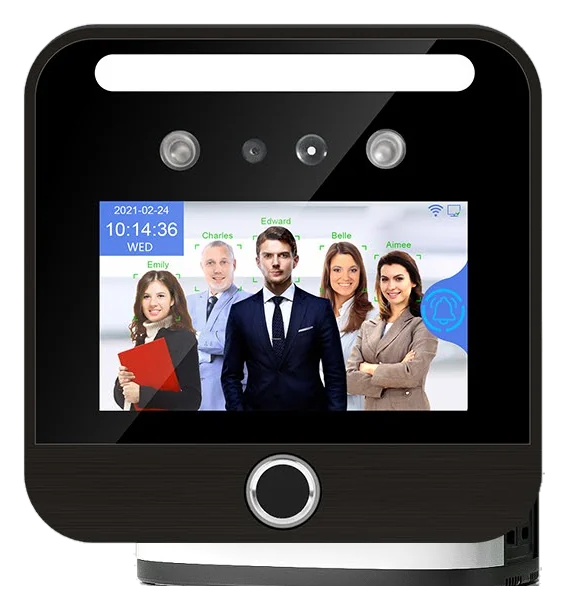
What this one is good at
Five at a time
A shift change is not a queue of one. This reads up to five faces simultaneously, tracking them across the frame, so a group arriving together is recorded as a group arriving together rather than a bottleneck.
Rated to −15°C
Working range −15°C to +45°C, and it stores down to −40°C. The only one of the four you can put on an unheated loading bay or an outdoor gate and expect to still work in January.
2MP WDR camera
A 2MP colour sensor with wide dynamic range plus a 2MP infrared sensor for liveness, and ambient light handling from nothing up to 50,000 lux, which is direct Cyprus sun on a white wall.
Room to grow
5,000 faces as standard and 20,000 as an option; fingerprints, cards and passwords 15,000 each, or 50,000. A group that keeps buying hotels does not outgrow the terminal.
Mask detection, and it can be turned off
It will check for a mask, or not, as you set it. Worth having on a kitchen door and worth switching off everywhere else, and either way it is your decision rather than ours.
It says happy birthday
Give it a date of birth and it says so when that person checks in. A small thing that has nothing to do with attendance, and staff notice it more than anything else on this list.
With Attendance
The door happens, and it is in the software.
This is not a terminal you buy and then find an export routine for. It is integrated with Attendance at attendance.cy, and a punch at this door is in the live view before the person has finished walking through it.
Real time, not a poll interval
The gateway holds an open stream and pushes every event the instant it happens. No refresh, no five-minute wait, no "last synced at". Somebody checks in and the board has them.
Three layers, so nothing is lost
The push is the fast path. Behind it Attendance polls on a watermark with a five-minute overlap, and behind that the terminal keeps its own log: up to a million events. Cut the network for a week and every punch still arrives, carrying the time it was made.
Straight into hours, not a spreadsheet
The punch becomes a shift, the shift becomes hours, and the hours become an approved payroll batch: in one record, with the corrections attached to it. Nothing is re-keyed and nothing is reconciled by memory at the end of the month.
You can see the terminal itself
Online or not, when it was last seen, and whether collection is current or overdue: per unit, in the portal. A terminal that quietly stops reporting is visible the same day rather than when somebody queries a missing shift.
Right for
- Outdoor or unheated doors: the only one rated below zero
- Shift changes where people arrive in groups
- Sites that will grow past 5,000 enrolled faces
- Turnstiles and floor stands, which it has brackets for
Not right for
A small back office. It is a 155mm square terminal with a five-inch screen, and on a quiet internal door the Q9 does the same job for less money and less wall.
Every angle
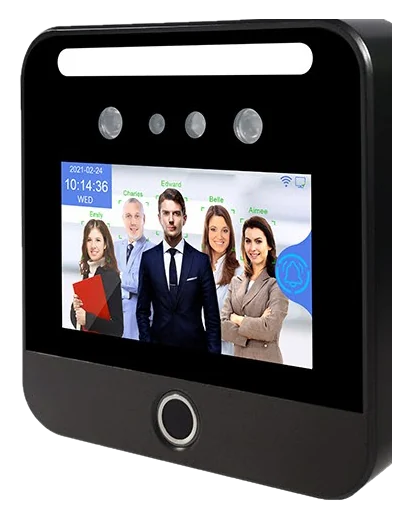
Front: 5″ IPS, 1280×720 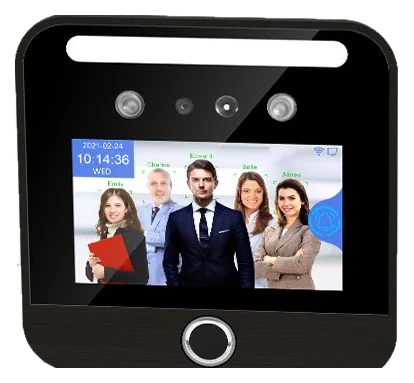
Three-quarter view
Specifications
Transcribed from the manufacturer's datasheet for the TM-AI03FP. Where a sheet is silent, the row is absent rather than filled in from a sibling model.
Recognition
- Methods
- Face, fingerprint, card, QR code, password
- QR code
- Supported Its own row on the datasheet, and easy to miss beside the face figures. This is the one terminal here that does every method on the list.
- Card
- ID card as standard, IC card optional
- Face accuracy
- 99.70%
- Recognition speed
- ≤0.2s
- Simultaneous faces
- Up to 5
- Recognition distance
- 0.5-2.5 m 0.5-1.5 m with live-face detection on. Settable to roughly 0.8 m, 1.5 m or 2-3 m.
- Cameras
- 2MP colour WDR (1/2.9″, 75° FOV) + 2MP infrared (1/5″, 75° FOV)
- Anti-spoofing
- Dual-camera live detection: refuses photographs, screens and video
- Mask detection
- Supported, and can be switched off
- Stranger capture
- Photographs an unenrolled face that appears in frame
- Ambient light
- 0-50,000 lux; infrared and white fill light
Capacity
- Faces
- 5,000 20,000 optional.
- Fingerprints
- 15,000 50,000 optional.
- Cards
- 15,000 50,000 optional.
- Passwords
- 15,000 50,000 optional.
- Stored events
- 500,000
Hardware
- Screen
- 5″ IPS touch screen, 1280×720
- Dimensions
- 155 × 155 × 25 mm
- Processor
- 1.2GHz dual-core ARM Cortex-A7
- Memory
- 256MB DDR3L / 4GB eMMC
- Operating system
- Linux 3.10
- Keypad
- Touch
- Current draw
- 310mA standby, 520mA working
- Mounting
- Wall mount and desktop stand as standard; turnstile bracket and floor stand optional
Doors and wiring
- Relay output
- 1 set
- Exit button
- 1 set
- Door magnet
- Supported
- Alarm
- 1 set output, plus external alarm
- Wiegand
- 1 set output
Power and network
- Power over Ethernet
- Supported One cable to the door: data and power on the same run, with no socket needed beside the frame. Confirmed by the manufacturer: the datasheets in circulation predate it and list only the DC supply.
- Backup battery
- Available The terminal keeps reading and keeps recording through a power cut, so the punches either side of it are still one shift. Confirmed by the manufacturer: this model's datasheet does not carry the row.
- DC power
- DC 12V 2A For a run with no PoE at the other end of it.
- Network
- Ethernet (TCP/IP), Wi-Fi
- Data transfer
- USB 2.0 host: import and export by USB stick
Attendance integration
- Live updates
- Real time, pushed The gateway holds an open stream and sends each punch the moment it happens. Somebody walks through the door and the live view has them, without a refresh and without a poll interval to wait out.
- If the network drops
- Nothing is lost The terminal keeps its own log, and Attendance polls the gateway on a watermark with a five-minute overlap. Reconnect and every punch made in the gap is imported, with its original time, not the time it arrived.
- Duplicate protection
- One punch, once The same event arriving by both push and poll is recognised as one punch, not two.
- Device health
- Online, last seen, collection state Shown per terminal in the portal, so a unit that has quietly stopped reporting is visible before somebody notices a missing shift.
- Verification status
- Certified on real hardware Seven checks recorded against a physical unit: every verification method, in and out direction, a disconnect-and-replay, a duplicate, an unknown enrolment, and a shift across midnight.
Environment
- Working temperature
- −15°C to +45°C
- Working humidity
- 20%-90%
- Storage temperature
- −40°C to +65°C
- Voice
- Text-to-speech name announcement, built-in bell
- Languages
- 20, with voice prompts
The other three
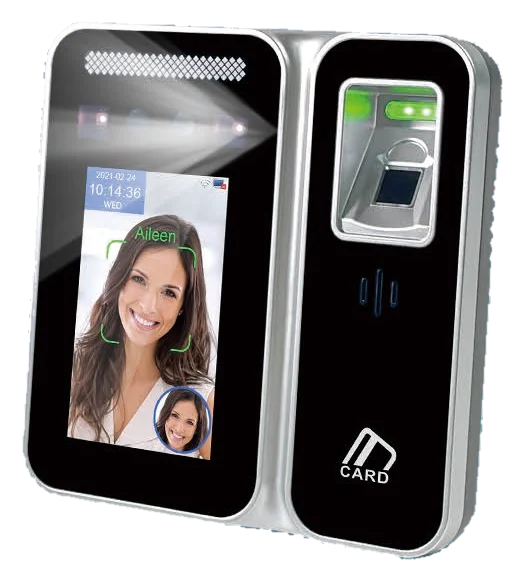 AI24F
AI24F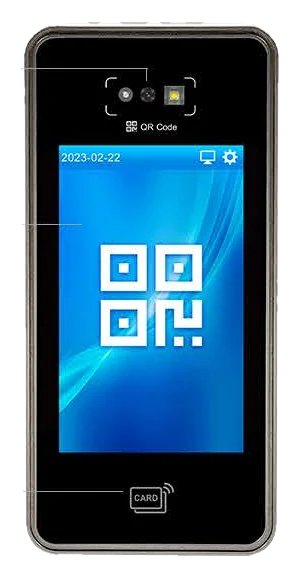 Q9
Q9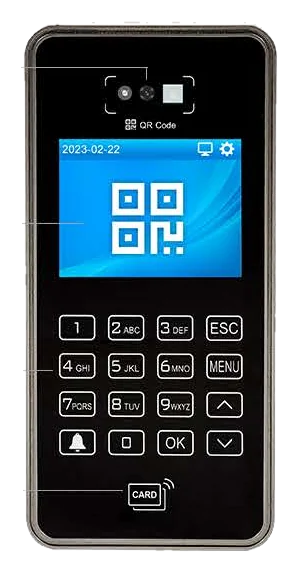 Q8
Q8The terminal is the part you can change your mind about.
Every one of these writes into the same record, so a site can run two models on two doors, or replace one in three years, without anything downstream noticing. What you are choosing here is how people get through a particular door, not a platform.
Talk about your doors